Discover what wood polymer composite (WPC) is and why it's the future of garden buildings. Compare WPC vs traditional timber.
If you've been researching garden rooms, you've probably come across the term 'composite cladding' — and you may have wondered what it actually is, and why we choose it over traditional timber for every garden room we build.
The material we use is called Wood Polymer Composite, or WPC. In this guide, we'll explain exactly what WPC is, how it's made, how it compares to timber, and why we believe it's the future of garden buildings — especially for homeowners in Buckinghamshire and Berkshire who want a room that looks beautiful and stays that way with zero maintenance.
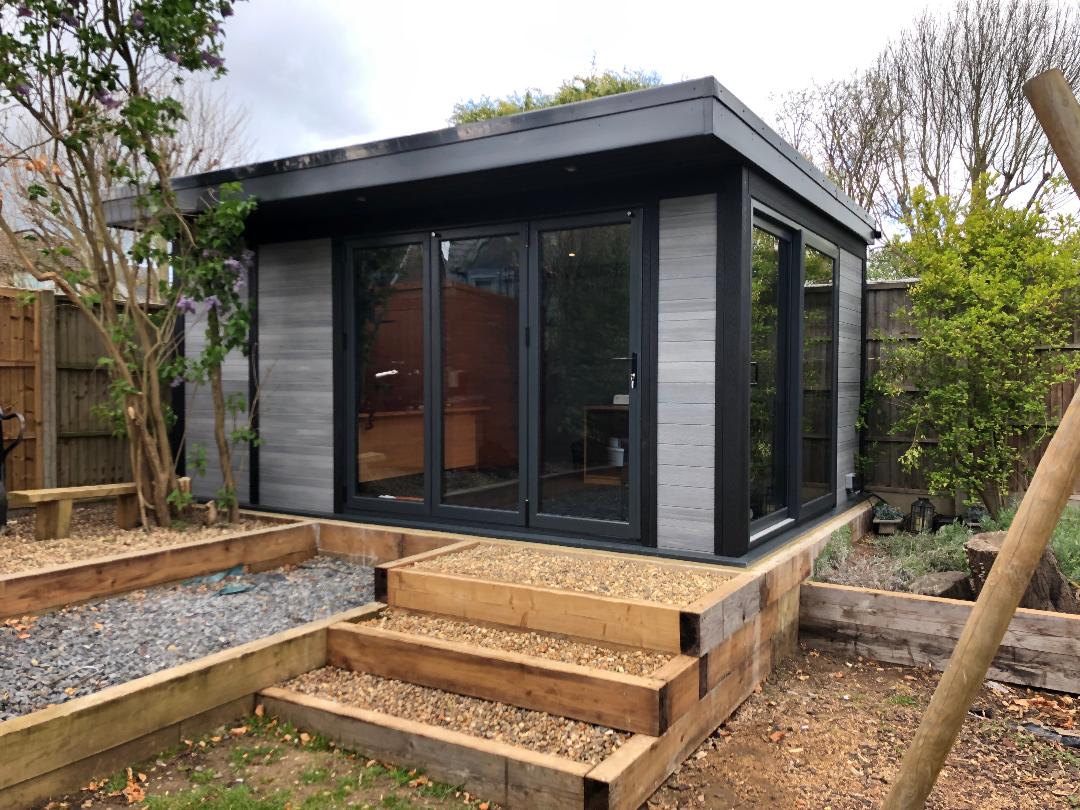
What Is Wood Polymer Composite (WPC)?
Wood Polymer Composite — often called WPC, composite wood, or simply 'composite' — is a material made by blending natural wood fibres with recycled plastics and a binding agent. The result is a board that looks and feels like timber, but behaves very differently.
A typical WPC board is made up of:
- Wood flour or fibres (around 50–60%) — usually reclaimed from sawmill waste or recycled timber
- Recycled thermoplastics (around 30–40%) — typically HDPE or PVC from recycled packaging
- Additives (around 5–10%) — UV stabilisers, colour pigments, and bonding agents
The mixture is heated, extruded, and pressed into boards with a textured wood-grain finish. The result is a material that has the warmth and appearance of timber, but none of its weaknesses.

How WPC Is Different from Timber
To understand why WPC is such a good choice for garden rooms, it helps to understand what happens to timber when it's exposed to the British weather.
Timber is a natural material. It absorbs moisture, expands when wet, contracts when dry, and is food for fungi and insects. To keep it looking good and structurally sound, it needs to be treated — usually every 1–2 years — with stains or oils that repel water and block UV.
WPC, by contrast, is engineered to resist all of these problems:
- Moisture: The plastic content makes WPC virtually impervious to water. It doesn't swell, warp, or rot.
- UV: UV stabilisers in the mix prevent the colour from fading in sunlight.
- Insects and fungi: WPC is not a food source, so it's immune to woodworm and rot.
- Temperature: WPC expands and contracts far less than timber, so boards stay stable and gaps don't open up.
WPC vs Timber: A Head-to-Head Comparison
Maintenance
- Timber: Needs treating every 1–2 years. If you skip it, the wood greys, cracks, and eventually rots.
- WPC: Zero maintenance. An occasional wash with soapy water keeps it looking new. No staining, no oiling, no sealing.
Durability
- Timber: Even well-maintained timber has a realistic lifespan of 10–15 years before it needs replacing.
- WPC: A typical WPC cladding board has a lifespan of 25+ years with no degradation.
Appearance
- Timber: Looks beautiful when freshly installed, but fades and silvers quickly without treatment.
- WPC: Available in a range of colours — dark grey, light grey, oyster grey, walnut — and holds its colour for the life of the board.
Cost
- Timber: Cheaper to buy, but the ongoing maintenance cost (treatments, labour, and eventual replacement) adds up over the years.
- WPC: Slightly more expensive upfront, but dramatically cheaper over the life of the building because there's nothing to maintain.
Safety
- Timber: Can splinter, and treated timber contains chemicals that can leach over time.
- WPC: No splinters, no chemical leaching, and many WPC boards are fire-resistant.
Sustainability
- Timber: Requires ongoing harvesting of new trees for replacement boards.
- WPC: Made from recycled wood and recycled plastic — diverting waste from landfill and requiring no new raw materials over the life of the building.
Why We Only Build with WPC
We made the decision to build exclusively with WPC cladding for one simple reason: it's better for our customers. We used to build with timber, and we saw the same problems again and again — customers calling us after two years asking why their room was greying, after five years asking us to replace rotting boards, and after ten years wishing they'd chosen a more durable material.
With WPC, those calls don't happen. The room we build today will look the same in ten, fifteen, even twenty years — with no work required from the homeowner.
It's not just the cladding, either. Our whole build system is designed around low-maintenance, long-life materials:
- Galvanised steel base frame — won't rot like timber joists
- Firestone rubber roof — one-piece, no joins, 25+ year lifespan
- WPC cladding — no treatment, no fading, no rot
- Double-glazed windows and doors — uPVC or aluminium, both maintenance-light
See how we put it all together in our build process →
Is WPC Right for Your Garden Room?
If you want a room that looks beautiful, stays warm, and needs no maintenance — yes. WPC is the ideal material for a garden room that's built to be used every day, all year round, for decades.
The only reason to choose timber over WPC is if you specifically want the look of natural, untreated wood and are prepared to maintain it. For everyone else, WPC is the better choice — and increasingly, it's the only choice offered by quality builders.
See our WPC garden rooms in our gallery →
Want to See WPC in Person?
The best way to appreciate WPC is to see it and touch it. Book a free consultation and we'll show you samples, talk through colour options, and help you choose the right finish for your garden room.